Pidilite Industries Leverages Rooftop Solar to Save on Power Bills

The company saved ₹1.41 million in the first three months after installing the 1.37 MW system

thumbnail

Follow Mercom India on WhatsApp for exclusive updates on clean energy news and insights


India’s industrial sector is increasingly adopting rooftop solar to offset rising electricity costs and improve energy efficiency within existing infrastructure constraints. Large manufacturing units, in particular, are leveraging distributed solar systems across factory rooftops to optimize available space while maintaining uninterrupted operations.

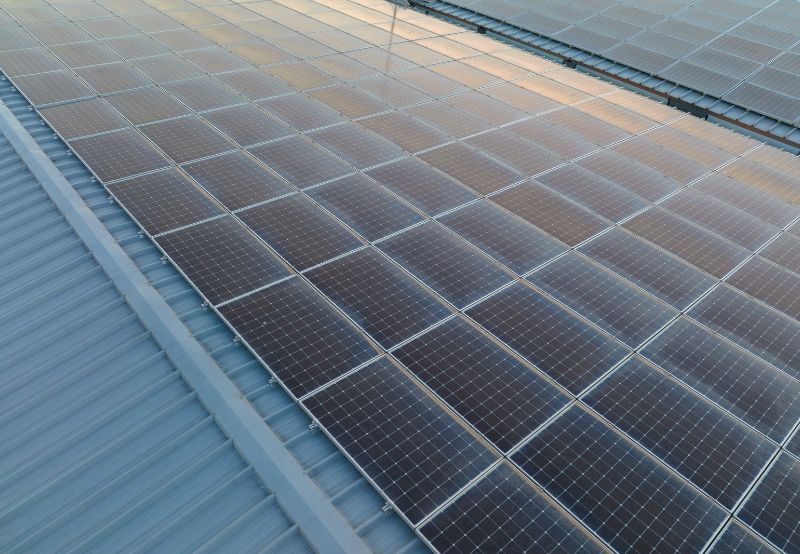
Chemicals manufacturer, Pidilite Industries, known for products such as adhesives, sealants, and construction chemicals, has installed a rooftop solar system with a total capacity of 1,378.7 kW across its manufacturing facilities in Himachal Pradesh. The installation spans five sub-factories and 15 rooftops with varying structural conditions, orientations, and load-bearing capacities.

The rooftop systems were commissioned in a staggered manner from November 2025 to January 2026. Within the first three of operation, the system generated approximately 1.3 million units of electricity, resulting in savings of ₹1.41 million (~$14,995) for Pidilite.

The project was designed to maximize generation within the available rooftop space and capital expenditure.

Pidilite Industries manufactures consumer and industrial products catering to sectors like construction, woodworking, packaging, and crafts.

Maharashtra-based renewable energy solutions provider Artha Energy Resources executed the project. The system uses Navitas 590 W non-DCR n-type TOPCon solar modules.

Artha Energy customized the system design to address multiple roof types and industrial conditions. Founder and Managing Partner Animesh Damani said, “We conducted detailed 3D shading analysis and structural stability assessments for each rooftop before finalizing the layout, thereby preventing potential leakage issues and maintaining structural integrity.”

The company deployed different mounting systems based on roof specifications, including non-penetrative ballasted structures for RCC roofs and specialized clamps for metal sheet roofing. This approach ensured that installations did not require drilling.

The system design incorporates multiple string inverters with independent maximum power point tracking. This configuration allows each section to operate independently, ensuring that lower performance in one area does not affect overall generation.

The modular design also enables the system to work around existing structures such as vents and chimneys without affecting performance.

Damani said, “Execution challenges were significant due to the facility’s operational nature. Installation activities had to be carried out without disrupting the plant’s continuous production schedule.”

The company said the non-penetrative design required lightweight and stable mounting solutions that could be installed without altering existing roof structures.

Last December, Artha Energy Resources installed a 332.30 kW rooftop solar system for Honeywell Industrial Automation at its facility in Dehradun.

Mercom India organizes nationwide ‘C&I Clean Energy Meets’ to connect solar developers with businesses exploring clean energy adoption. These events are designed to bring key stakeholders together on a single platform and promote greater awareness of the advantages of transitioning to solar energy among commercial and industrial consumers.

The next event will be held in Jodhpur on May 15, 2026.

RELATED POSTS

Get the most relevant India solar and clean energy news.

RECENT POSTS